Confused by the headlines around wood burning stoves? This guide explains PM2.5, modern Ecodesign stoves, dry wood, smoke control areas and why open fires, outdoor burning and older appliances should not be treated the same as a modern wood burning stove.
Quick guide: What is PM2.5? | Does a stove pollute your house? | Ecodesign stoves | clearSkies | Wood fuel quality | Bans and fines
Most of the press seems concerned with PM2.5, so what is it?
PM stands for particulate matter and 2.5 refers to size. PM2.5 is a particle that is less than 2.5 microns in diameter. These fine particles can be inhaled into the lungs and could cause adverse health effects.
- In general, the average annual concentration of PM2.5 in the air has been decreasing. Concentrations of PM2.5 tend to be greatest in urban environments in the southern and eastern areas of the UK. This is due to a variety of factors, including higher population density, weather conditions and greater exposure to pollution sources from mainland Europe. Read the GOV.UK PM2.5 statistics.
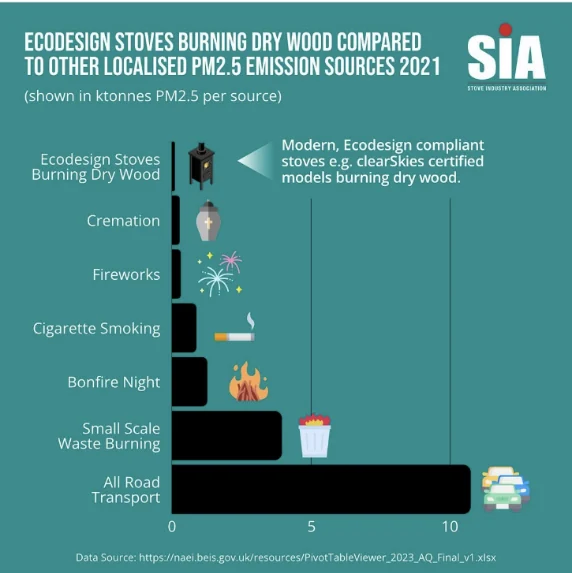
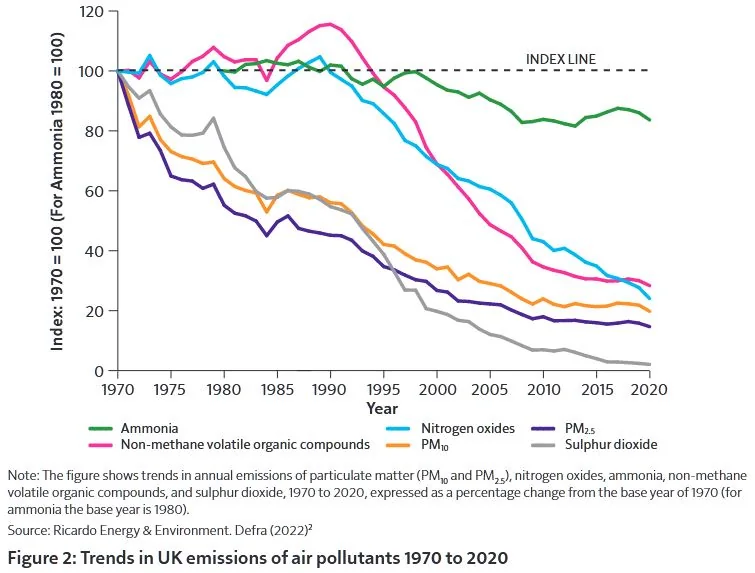
Air Quality News reported a decline in UK nitrogen oxide and sulphur dioxide levels.
- London Air found that PM2.5 was higher in March, April and September than in the winter months. This suggests most PM2.5 does not come from wood burning that would happen in the colder winter months. View London Air data.
- The actual contribution of PM2.5 from modern wood burning stoves is estimated by the UK government’s official figures at just 1-2%. Read the Stove Industry Association article.
- The small amount of PM produced by a modern wood burning stove goes up the chimney and into the atmosphere, rather than being breathed in at head height. Brake and tyre dust from cars is much closer to head height. A study by the Organisation for Economic Co-operation and Development found that heavier electric cars can cause more road and tyre wear for both larger PM10 particles and smaller PM2.5 particles than petrol or diesel cars. Read the OECD report.
Does a stove pollute my house?
A report by Dr Amanda Lea-Langton, senior lecturer in Bioenergy Engineering at the University of Manchester, found that modern wood burning stoves may actually improve home air quality. When the fire is in use, it pulls polluted air from the house to the stove and up the chimney to outside. Read Charnwood’s summary of the indoor air quality report.
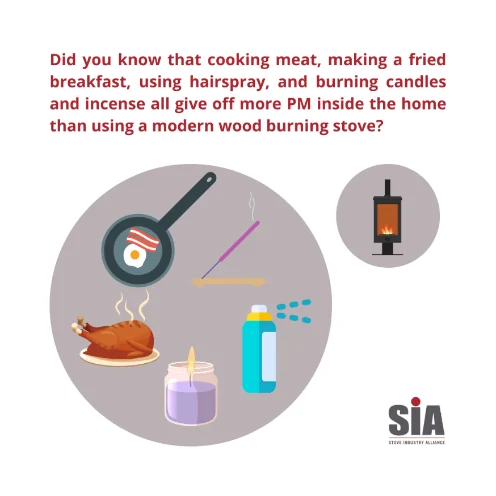
Did you know that cooking meat, toasting bread, using hairspray, and burning candles and incense can all give off more PM inside the home than using a modern wood burning stove?
Not all wood burning is equal
Outdoor burning
Burning wood on a fire pit, chiminea or bonfire does not come under the DEFRA Clean Air Act legislation in the same way as wood burners. This is because the smoke does not go up a chimney.
Outdoor burning is more recreational than indoor stove use, so it is a shame there is less regulation. Most wood burning pollution figures include outdoor burning, which is misleading. Outdoor burning produces far more pollution than any stove, especially an Ecodesign stove. Read the Stove Industry Association report on domestic outdoor burning.
Ecodesign
From January 2022, every stove manufactured had to meet a new regulation which sets a standard for efficiency and emissions. All stoves have to be below a certain level for particulate matter, carbon monoxide, organic gaseous compounds and nitrogen oxide.
We have been selling these stoves since 2017. If you bought your stove before this time, or your stove was placed on the market before January 2022, this legislation does not apply to you. Read the Which? guide to wood burning stove rules.
[image here – ecodesign-ready-pm-reduction.webp – 500x500px centre align]
clearSkies: improving on Ecodesign
- The wood burning stove industry continues to improve and has introduced an initiative that is clear for consumers: clearSkies.
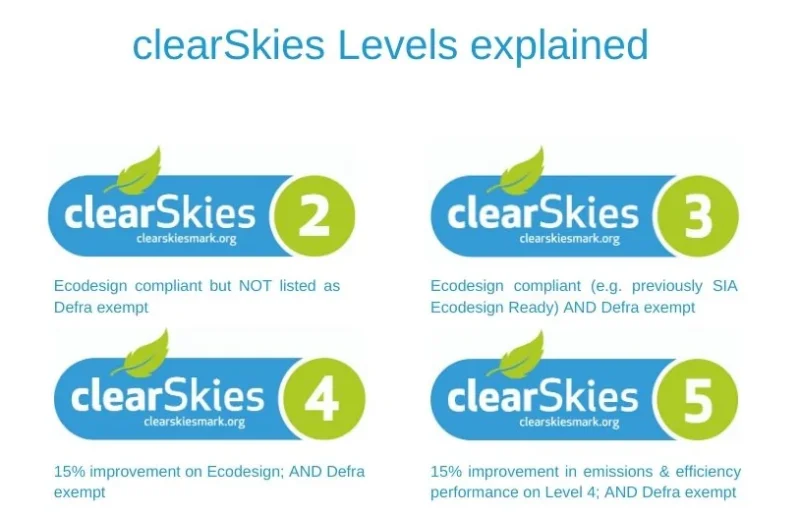
- Some of Charnwood’s Ecodesign stoves are rated clearSkies 5. These are 11% more efficient, produce 28mg/m3 fewer particles, 6% less carbon monoxide, 60mg/m3 fewer organic gaseous compounds and 108mg/m3 less nitrogen oxide than the Ecodesign standard. Read the Charnwood clearSkies brochure.
Using wood as a fuel
- Wood is renewable in our lifetime, unlike gas and most of our electricity.
- When trees grow, they take in carbon dioxide. Burning wood releases the same amount of carbon dioxide as if the wood was left to rot. Therefore, burning wood can be considered carbon neutral.
- Firewood tends to come from managed forests and natural tree loss. Forests need to be managed and thinned out to promote biodiversity and a thriving woodland. Read the Forest Research guide to wood as fuel.
Quality of wood
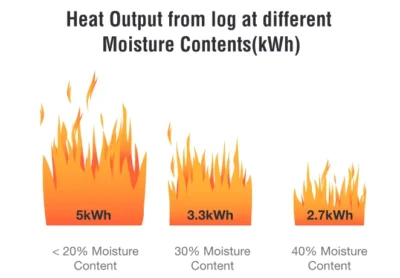
Burning wet wood will lead to less heat, with more smoke and emissions. It is extremely important that wood is seasoned, which means left to dry, for at least a year or kiln dried.
In 2020, the government introduced legislation that all wood sold in quantities under 2 cubic metres should be less than 20% moisture. Look for the Woodsure or Ready to Burn logo. Read DEFRA’s Burn Better guidance.
Suggested extra text: If you are unsure whether your logs are dry enough, use a moisture meter before burning. It is a simple way to reduce smoke, improve heat output and protect your stove and flue.
Are they going to ban wood burners? No.
- The Environment Improvement Plan published by the government in 2023 states that they are not considering a ban on domestic burning. Read the Environment Improvement Plan executive summary.
- The government has recently introduced legislation on selling wet wood and Ecodesign stoves. Both moves are supported by the wood burning industry.
- Some houses are totally reliant on wood burners for cooking, heating and producing hot water, so a ban could be harmful to those households. Warmth is a human right. Read the Scottish Human Rights Commission poverty report.
Can you be fined for using your wood burner?
- If you live in a city that is within a DEFRA smoke control area, locally central Bristol or Bath but not Swindon, you are not allowed to burn wood on an open fire. You can only use approved smokeless fuel.
- You can only burn dry wood, which is a non-approved fuel, on a DEFRA exempt appliance such as a clearSkies 3 or above stove.
- You cannot burn wet wood or house coal.
- The legislation states that a DEFRA exempt appliance is only allowed to emit smoke when lighting your fire while getting it up to temperature, and then less than 3 grams of smoke per hour thereafter. Read the Which? wood burning stove rules guide.
- The law on being fined for burning has not changed. The rules have been tightened so that wood should be below 20% moisture and only smokeless approved fuels can be burnt. There is a maximum fine of £300 after you receive several warnings.
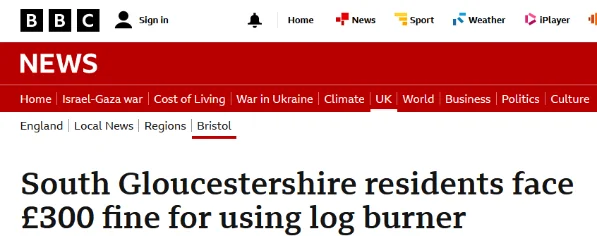
In April 2024, the BBC reported the following:
[image here – bbc-log-burner-fine-headline.webp – 650x260px centre align]
This headline says that residents would face a fine for using a log burner in South Gloucestershire. However, when you read the article, it explains that the council approved penalties within the very small DEFRA smoke control area, including Bradley Stoke and Bristol within the M4 and M5, to encourage fuels and appliances to be used correctly. Read the BBC article.
If you follow the rules, you will not get a fine.
In conclusion
Everything we do as humans has an environmental impact. We believe that making informed choices is important.
The negative headlines are frustrating for our industry when the media does not give the whole picture. We are a small industry that does not have a big association to squash incorrect headlines. However, the Stove Industry Association is doing its best.
Our manufacturers are putting money into improving their products and reducing the PM2.5 emissions produced. The reality is that UK PM2.5 emissions have been steadily decreasing over the years despite record stove sales. Read Charnwood’s article on anti-wood burner data.
The hard truth is that whatever fuel or heating appliance we, as the human race, decide to use, whether gas, electric or biomass, it will have some sort of environmental impact. We believe that wood burning on a modern appliance has a well-deserved place alongside renewable electric and alternative gas.
Suggested CTA: Need advice on choosing a modern Ecodesign or clearSkies-rated stove? Speak to our team or visit the showroom for practical guidance on stove size, fuel, chimney requirements and installation.